Prediction Markets Go Global, But Where Are They Actually Legal?
Prediction markets are booming in the iGaming and fintech industries, with applications extending beyond sports. But what are they really? Financial exchanges, gambling platforms, or something in between?
 Alissa Bergman

There is still much debate among politicians, regulators, operators and investors over how prediction markets should be treated, and consensus is unlikely anytime soon. The answer determines key issues such as licensing, taxation, age limits, advertising and responsible gambling obligations. Regulators across North America, Europe, Latin America and Oceania are taking very different approaches.
US: The Biggest Market, the Biggest Legal Battle
The US is at the centre of the prediction-market boom — and the regulatory fight surrounding it.
At a federal level, the Commodity Futures Trading Commission (CFTC) classifies event contracts as derivatives. The regulator has overseen prediction markets since 2004. In March 2026, the CFTC proposed new rules for prediction markets, noting that the number and variety of event contracts had grown significantly since 2021, and that it had received applications and expressions of interest from companies that were specifically focused on prediction markets.
The problem is that states often view event speculation as gambling rather than financial trading, and sports — the largest and most profitable segment — is the biggest flashpoint. In 2026, the CFTC sued states including Wisconsin and New Mexico after officials challenged platforms such as Kalshi; they argued that federal law gives the commission exclusive jurisdiction over these contracts.
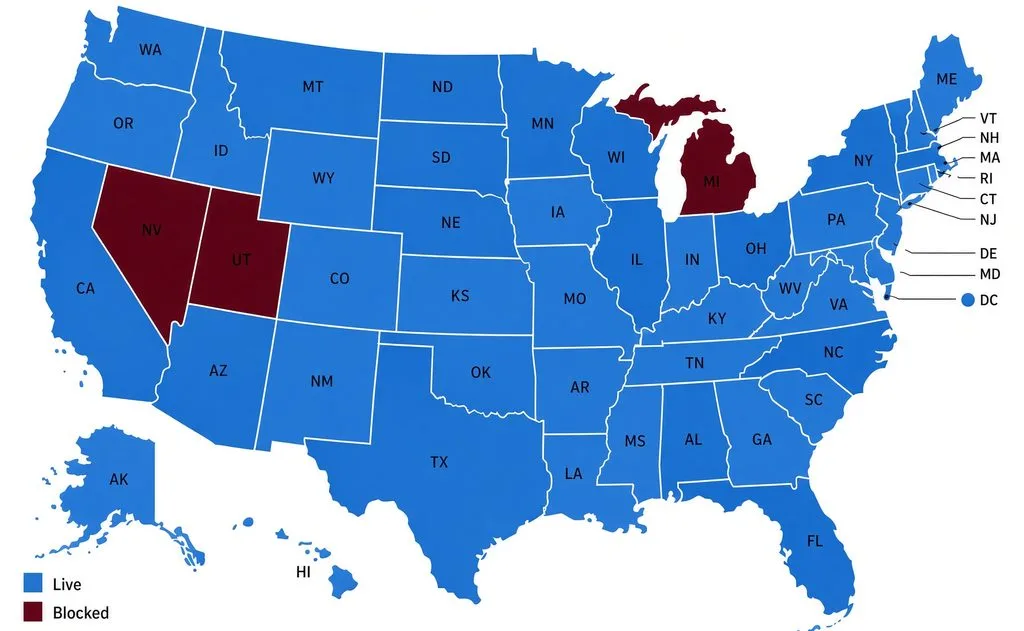
Where prediction markets are live and restricted, by October 2026.
Many states argue that sports event contracts bypass gambling laws, licensing, consumer protections and taxes tied to online betting, legal in 32 states. The financial stakes are high: Ohio alone collected over $160 million in online sports betting taxes in 2024.
Among other states, New York is suing both Kalshi and Polymarket over sports prediction markets. The state argues that these platforms offer unlicensed gambling and that their products should be subject to state gambling rules.
The dispute has now reached the US Supreme Court. On October 8, the NFL filed a brief supporting state-level regulation, arguing that sports prediction markets create integrity and consumer-protection concerns. The Supreme Court has yet to decide whether to hear the case.
The key US question for businesses is this: can a CFTC-regulated exchange offer contracts nationwide, even when individual states consider those contracts to be illegal betting? Until the courts provide a definitive answer, market access will remain vulnerable to state-by-state challenges.
Canada: Financial Rules on One Side, Gambling Rules on the Other
Canada is taking a more cautious approach. There’s also no clear nationwide framework: operators have to contend with financial regulations and gambling laws in each province, and legality depends on the type of contract and where it is offered.
In April 2026, Canada’s securities regulators warned that some prediction-market contracts may be classified as financial products. Platforms offering or facilitating these contracts may need to register with regulators to operate legally.
In August, British Columbia’s gambling regulator clarified that sports and entertainment prediction contracts should be treated as gambling, not financial products. In the province, legal online gambling is restricted to the provincial system operated by BCLC through its PlayNow platform.
Europe: Not a Homogeneous Market
Europe is taking a more restrictive approach. In 2026, several European countries, including France, Spain, Belgium, the Netherlands, Germany, Portugal, Italy, Romania, Poland and the Czech Republic, have blocked or restricted access to unlicensed prediction-market platforms. There is no single European rulebook, but regulators argue that unlicensed services fall outside national gambling frameworks and lack the safeguards required of authorised operators.
In July 2026, the European Securities and Markets Authority (ESMA) issued a warning to firms regarding the increasing popularity of prediction markets and retail participation. ESMA also acknowledged that some contracts could qualify as gambling under national laws.

Meanwhile, some European markets are exploring ways to accommodate prediction markets. Gibraltar has introduced a dedicated licensing framework, while Malta is considering introducing more specific rules based on existing gambling licences. In the UK, operators must comply with either existing gambling or financial services regulations, depending on the products they offer.
For businesses, Europe is therefore a fragmented market rather than a straightforward growth opportunity. While some financial event contracts may qualify for authorisation under financial services rules, sports and political prediction markets often face restrictions under national gambling laws.
Latin America: Early Enforcement Is Setting the Tone
Latin America is even more fragmented, but recent developments suggest that regulators are not waiting for prediction markets to become established before acting.
Brazil, which was regarded as a promised land by iGaming providers, may be considered a good example. In April 2026, the government demanded that the prediction market websites providing betting on elections, entertainment, and sports be blocked. Then, just days before the general elections in October 2026, Lula announced a ban on online sports betting and gambling, leaving prediction-market operators with few legal options.
Colombia has taken a similar position on political prediction markets. In September 2025, the gambling regulator Coljuegos requested that Polymarket be blocked, stating that betting on electoral events was not regulated in the country and therefore constituted illegal gambling.
Mexico illustrates the uncertainty present elsewhere in the region. Its gambling framework requires permits for betting-related activities, while those not expressly permitted by law are prohibited. In March 2026, lawmakers proposed examining how digital prediction markets should be classified and regulated, but ultimately discarded the proposal in May.
Overall, Latin America remains a patchwork of rules, and sports betting licences do not automatically cover prediction markets.
Australia and New Zealand: A Difficult Territory
Australia is taking a cautious approach. In 2026, ASIC warned that prediction markets are illegal without the required authorisation and that offshore platforms do not offer the same consumer protections. FEXGlobal has expressed interest in launching a licensed platform, but had not submitted a formal application at the time of the warning.
New Zealand takes a stricter position, classifying prediction markets as gambling and bookmaking prohibited under its current Gambling Act. The country is separately developing a licensing regime for online casinos, expected to become operational in 2027, while sports and racing betting remains under TAB NZ.
Both Kalshi and Polymarket are blocked in the region, and for prediction-market businesses, the message from Oceania is fairly clear: demand does not automatically translate into a legal route to market.
Asia: Few Open Doors
Several Asian jurisdictions adopt a strict stance on prediction markets, classifying real-money event contracts as gambling rather than financial trading. For example, Singapore has blocked Polymarket as an unlicensed gambling service, while Japan and South Korea impose strict restrictions on gambling outside of authorised categories. These rules leave prediction-market operators with few clear routes to legal operation. South Korea has even initiated a criminal investigation into residents’ use of Polymarket under the country’s broad gambling prohibition.
For now, Asia remains a difficult market for prediction platforms, with strict gambling laws and limited licensing options leaving little room for legal expansion.
To Sum Up
There are three main possible regulatory paths for prediction markets: financial products, gambling services, or a hybrid of both. While some jurisdictions treat event contracts as derivatives, others apply gambling laws, particularly to sports markets. A hybrid model could offer a middle ground with different rules for financial and non-financial events. Operators’ future growth will depend on their expertise in which rules apply to each product and where it can legally be offered.