The State of VIP Operations: Where iGaming’s VIP Teams Are Losing Time
A new report, The State of VIP Operations, examines the teams behind one of iGaming’s most valuable functions and finds that they are still heavily reliant on fragmented data and individual judgment.
 Alissa Bergman

The report, produced by The Playa, Gaming Operations Academy, and WarriorLab, surveyed 70 VIP professionals in 2026. The online survey examined how VIP teams manage players, data, technology, and daily operations. While the findings are directional rather than statistically definitive, they paint a revealing picture of how VIP teams operate today and highlight the key challenges affecting their work.
About the companies
- The Playa — An AI-powered personalisation company helping iGaming operators turn player data into personalised experiences across the player lifecycle.
- Gaming Operations Academy — A training and professional development partner focused on compliance, player safety and operational capability.
- WarriorLab — A specialist iGaming consultancy company focused on B2C operations, VIP programme design, player development, retention and analytics.
People Behind the VIP Experience
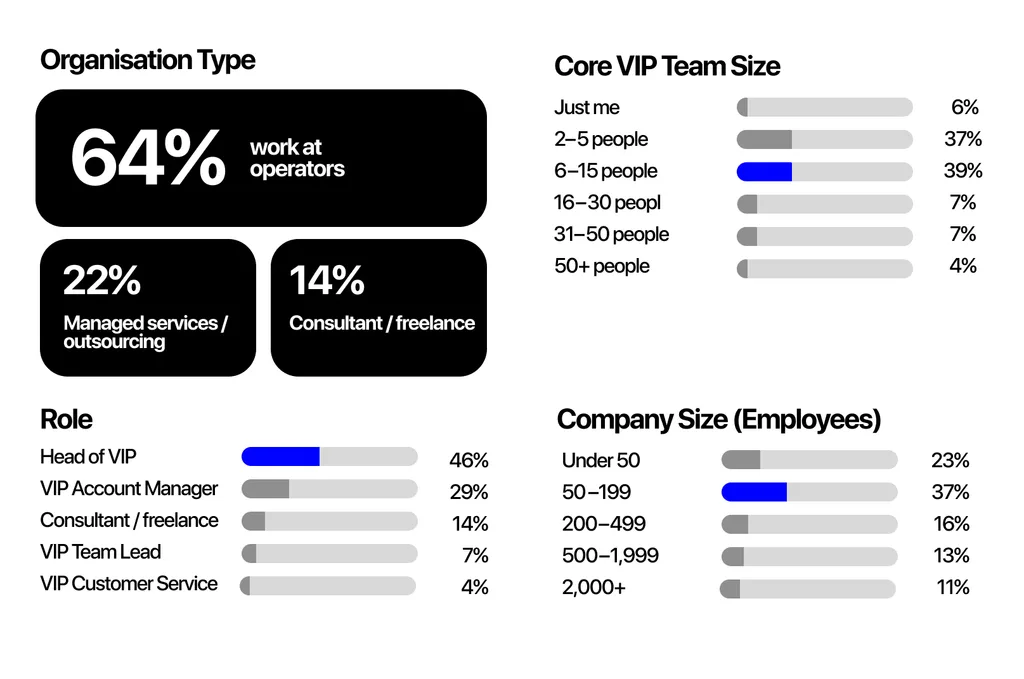
Respondent Profile. Source: The State of VIP Operations report
In iGaming, VIP operations are generally run by experienced professionals in fairly lean teams. 81% of respondents have at least 3 years’ experience in VIP operations specifically and 82% work in core teams of 15 or fewer.
However, job titles do not tell the whole story.
On average, respondents personally cover four different VIP functions. The most common is account management, but half also cover VIP customer service. Others are involved in onboarding, training, CRM, quality assurance, and team leadership.
In other words, being a VIP manager rarely means doing just one job with narrow, repetitive tasks.
VIP teams also sit relatively close to the top of the organization. According to the report, 41% of VIP functions report directly to a CEO or COO. This gives them visibility, but raises another question: if their function is so important, why they often rely on the most basic technologies, such as spreadsheets and BI dashboards?
Lack of Data Is Not the Problem
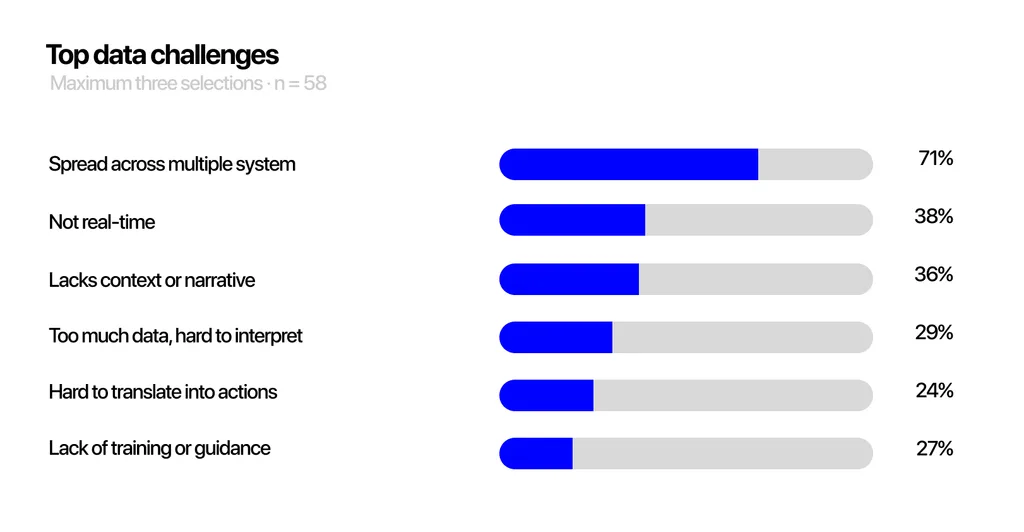
Data challenges for VIP teams. Source: The State of VIP Operations report
According to the report, VIP teams do not necessarily believe that their data is poor or insufficient. In fact, 76% rate the quality of their data as good or very good.
The problem lies in where that data lives and how easily it can be accessed for fast and accurate decision-making.
71% of respondents say their VIP information is spread across multiple systems, and 50% say they sometimes make decisions using incomplete or stale information.
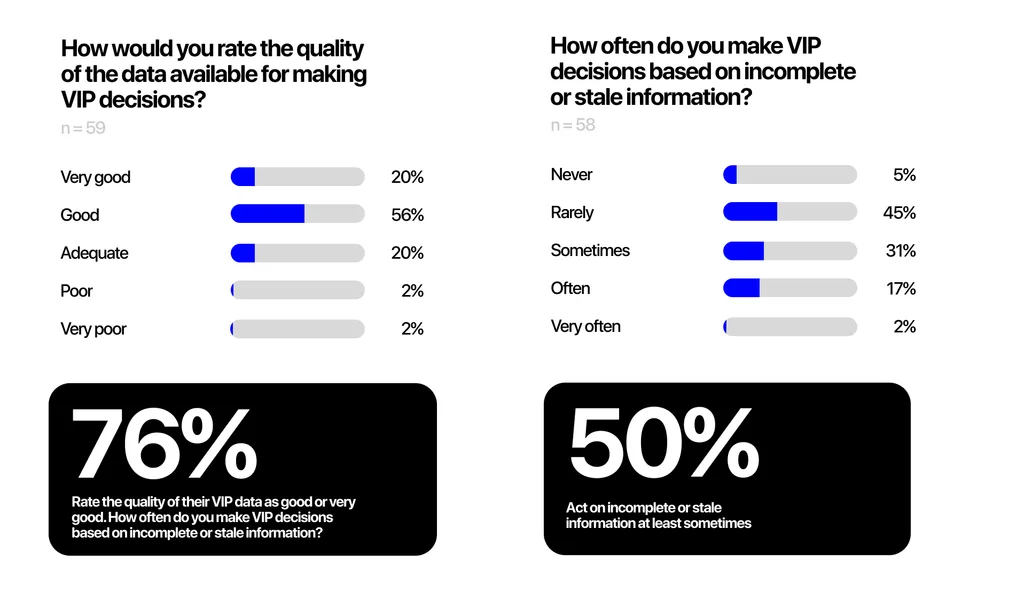
Data quality evaluations. Source: The State of VIP Operations report
Not a single respondent identified a purpose-built VIP tool as their primary system. Spreadsheets and BI or reporting dashboards are tied at 30%, followed by CRM systems at 24%. Meanwhile, AI and automation tools still account for 0% as a primary system.
That does not mean VIP teams are operating without technology; they are using plenty of it. The issue is that the technology stack does not necessarily bring everything together at the moment when a decision needs to be made.
As the report describes, the challenge is less about having more data and more about providing the right information to the manager at the right time.
This distinction could become increasingly important as VIP portfolios grow.
“Look at what actually fills the week — reviewing data, pulling reports, logging notes, chasing other teams. At least a third of those hours is mechanical work that dedicated VIP software can absorb, which is four to six hours a week handed back to the players.“
“Only 7% cite a training or capability gap. VIP managers know how to read their data — they simply cannot get it into one place fast enough to act on it,” said Viktoriia Grygorenko, CEO at The Playa
When 250 Players Become a Numbers Game
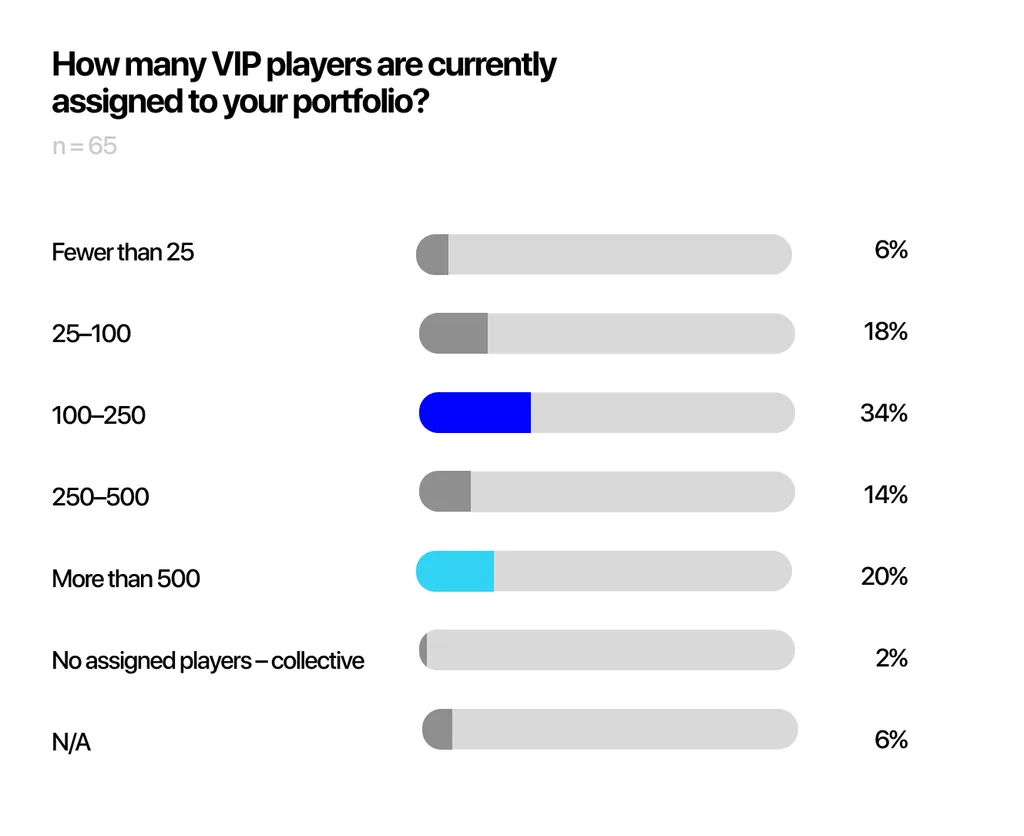
Data quality evaluations. Source: The State of VIP Operations report
A personal approach sounds like the basic work routine for VIP management — until you consider the size of some portfolios.
One-third of respondents manage between 100 and 250 VIP players, and 20% manage more than 500. Overall, 45% of respondents identify portfolio overload as one of their biggest workload challenges.
The report contextualizes this with the so-called “attention arithmetic”: the loudest and the largest get contacted, and the quieter middle remains overlooked, and this is exactly where undetected churn builds up.
“Portfolio size is the single variable that determines whether VIP treatment can be genuinely personalised or has to fall back on generic, one-size-fits-all handling. Above roughly 150 players per manager, personal knowledge stops scaling. The fix is not fewer players or more managers — it is showing each manager which few accounts actually need them today,” noted Viktoriia Grygorenko.
Imagine a manager overseeing 250 players with a seven-hour workday. Before reporting, escalations, bonus processing and internal coordination are taken into account, that leaves roughly 100 seconds per player per day.
It’s not enough time to understand a player’s behavior, notice changes, and decide how to proceed. And this is where the difference between proactive and reactive VIP management becomes clear.
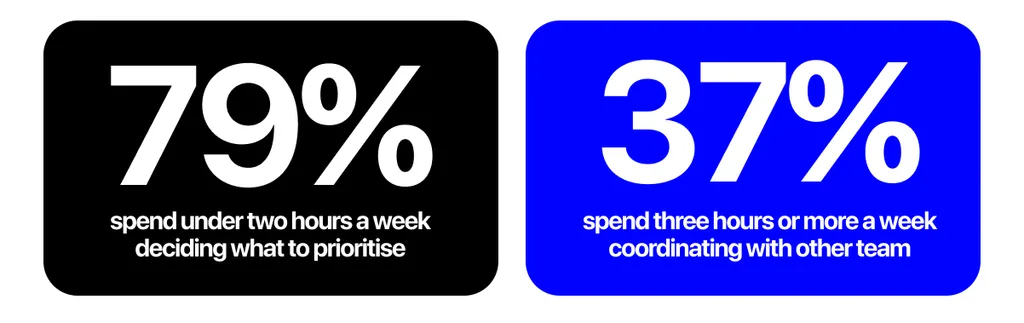
VIP teams’ workload. Source: The State of VIP Operations report
According to the survey, half of respondents describe their work as reactive rather than proactive. 43% point to excessive manual reporting and administration, while 32% say they lack a clear view of which players need attention right now.
The result is a familiar problem: most visible players tend to get noticed first. The loudest player. The biggest player. The one who just contacted the team.
But what about the player who has started depositing less and less, or abruptly stopped playing altogether?
The Role of Metrics and Silent Churn
There is also a difference between how VIP teams operate and how VIP players are measured. 72% describe themselves as relationship-led in their approach, but revenue is still the primary focus with NGR, deposit volume and GGR being the primary KPIs. Retention and LTV, meanwhile, are a much lesser focus.
This is important because the teams are expected not only to generate quick income but also to identify potential VIPs, build relationships with them, and maintain those relationships over time. Indeed, 40% of respondents personally oversee VIP onboarding or pre-VIP hosting alongside other VIP functions.
The same measurement gap can make silent churn harder to detect. Players can become inactive without warning, and many teams lack clear behavioral indicators. The result is a familiar problem: lots of data but not the right metrics or tools to convert it into early warnings and prompt action.
Personalisation Is Still People’s Responsibility
Replacing VIP managers with AI is not the answer.
Quite the opposite: most VIP players expect individual attention and personal relationships. But AI can help managers prioritize and act faster.
The report also finds that 75% of respondents rate the need for a tool that identifies each player’s highest-priority action at 8 out of 10 or higher. At the same time, losing the human touch when implementing AI tools is the main concern, cited by 38% of respondents. Another 25% are wary of trusting AI over their own judgment.
This offers an insight into how VIP professionals view technology.
They don’t need a machine to help them with their workload or manage human relationships. They are asking for help deciding where to focus their attention.
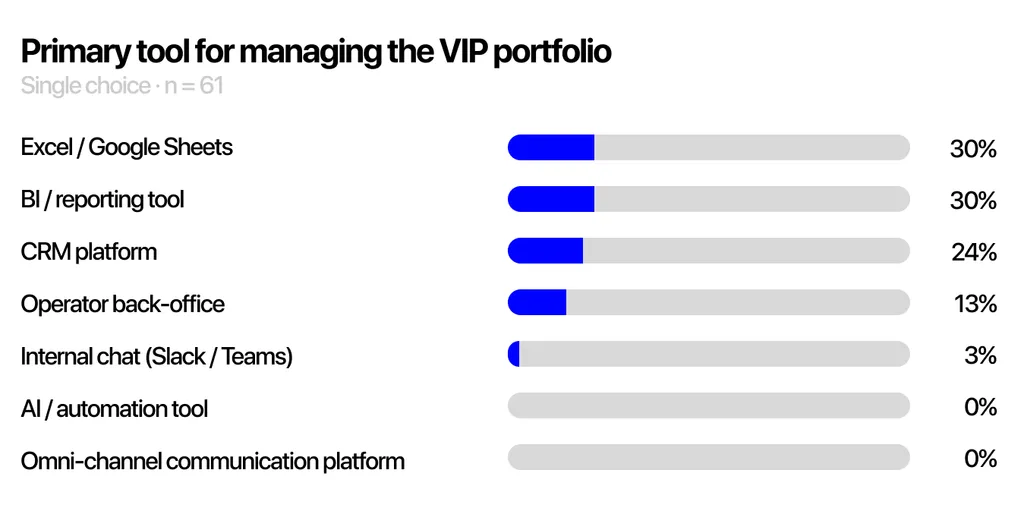
Main tools. Source: The State of VIP Operations report
A system could identify for a manager which players need attention, why they need it, and what action is appropriate. AI-powered analytics can convert fragmented player data into clear insights and help prioritize the next best action in real time, in seconds. Then the manager can bring their experience, judgment, and personal, human approach that technology cannot replicate.
In that sense, the report frames AI not as a replacement for VIP teams, but rather as a means of eliminating some of the time-consuming administrative tasks associated with them.
“Middling satisfaction is the most expensive kind. Tooling that is merely tolerable never becomes a priority, and the manual work it generates is absorbed as a normal cost of doing business,” said Gali Hartuv, CEO and Co-Founder at WarriorLab.
To Sum up
VIP might be built on relationships, but the report shows that too much time is still spent managing the processes behind them. The next step isn’t replacing the human touch, it’s giving VIP teams better tools, clearer signals and more time to focus on the players themselves.