SOFTSWISS 2027 iGaming Trends Report: A More Connected, More Complex Industry
The iGaming industry is growing in size, sophistication and connectivity — but also in complexity
 Alissa Bergman

The fifth edition of SOFTSWISS’ 2027 iGaming Trends report offers more than the usual industry forecasts, with insights from over 500 professionals, 65 expert interviews and analysis of more than 480,000 media headlines. The 156-page report also looks outside the iGaming space, comparing the industry to sectors such as e-commerce, streaming, gaming and crypto.
AI Is Everywhere. What about Its True Value?
AI has moved beyond the hype stage. Although over 80% of betting and gaming companies have adopted generative AI, the industry’s overall AI maturity score is only 45 out of 100. It’s clear that adoption is not the hard part; the next step is making AI reliable production tools that can be measured.
“By 2027, I think we’ll see the role of a junior analyst shift meaningfully: less responding to alerts and more directing the agents who respond to them. Tier 1 becomes supervisory rather than executory,” said Craig Lusher, Principal Solutions Architect at EMEA, Continent 8 Technologies
Agentic AI is the next stage and is a hot topic now. Instead of simply helping employees complete basic tasks, AI systems handle entire workflows, from fraud and compliance to personalisation and customer support.
The report points to a broader shift in how AI creates value, with some of the clearest returns coming from reducing the time needed to complete everyday work rather than replacing people.
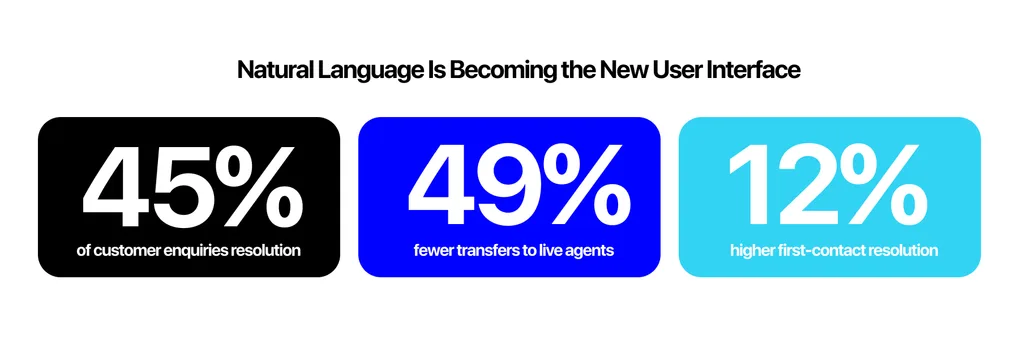
The study highlights several figures on improvements to the user experience:
Source: 2027 SOFTSWISS iGaming Trends Report
Now, the bigger challenge for the industry is turning adoption into measurable impact — improvements in productivity, operations and commercial performance.
Payments Could Start Optimising Themselves
Payments are seeing the same evolution from manual work to automation, where machine learning would increasingly choose providers and redirect traffic based on factors like approval rates, costs, providers’ performance, and market conditions.
The forecast is ambitious: in the next year or two, ML might handle more than 90% of routine routing-rule changes, enabling payments teams to focus on strategic allocation and exceptions. This matters because payment performance correlates directly with player loyalty; the report cites research showing that 82% of players stay loyal to brands that provide seamless deposits and fast payouts, while repeated payment failures drive players away.
The direction is obvious. Ultimately, if routing rules can change faster than a human team can evaluate them, the smartest payment system may be one that requires little to no management.
“The payment team’s daily input will shrink to just a few minutes – focused strictly on strategic traffic allocation across PSPs and handling edge-case emergencies,” says Mikita Revaka, Chief Operating Officer at FinteqHub.
Betting Is a Broader Experience
The report also sees the boundaries of betting getting wider. Sportsbooks are competing not only on odds, but on how much interaction they can create around an event. On the SOFTSWISS Sportsbook, the ratio of pre-match to live bets is approximately 1:5, suggesting that much of the action happens while the event is actually taking place.
Prediction markets, embedded betting and other forms of “ambient” wagering take this a step further. Prediction markets are especially interesting: SOFTSWISS says its product has secured 50 signed agreements in just months after launch.
“In my view, the biggest trend shaping iGaming in 2027 and beyond will be the widening definition of betting. We will see growing convergence between traditional sportsbooks, prediction markets, media, gaming and other forms of digital entertainment.This transition is already taking place in sports betting. Players are no longer satisfied with placing a single bet before a match and waiting for the result. They want to interact continuously with the event,” said Alexander Kamenetskyi, Head of Operations at SOFTSWISS Sportsbook.
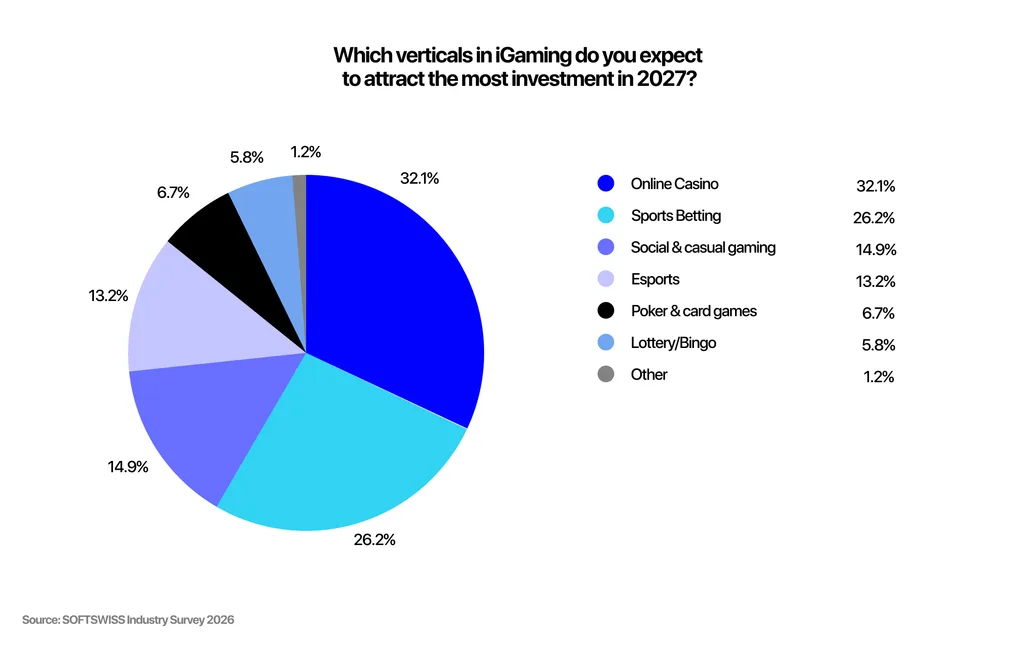
At the same time, established verticals are still expected to attract most investment in 2027:
Source: 2027 SOFTSWISS iGaming Trends Report
So the future may not be about replacing casinos and sportsbooks with new categories. It may be about connecting them with new forms of entertainment.
Mobile Sets the Pace
One of the industry’s most established trends remains crucial: mobile. The report’s regional forecasts show just how important mobile is in emerging and high-growth markets, with mobile accounting for 91% of online gambling in Africa, 79% in Asia and the Middle East, and 82% in North America. The overall mobile’s share of onshore GGR is estimated to reach 78% in 2028.
This means mobile more than a device preference. It is part of the infrastructure through which new players enter the market, particularly in regions where desktop-first digital behaviour never became the norm.
Players Don’t Want the Noise
Gamification and bonuses remain the leading engagement mechanics for 2027. But the report makes an important distinction: the solution is not more promotions or more aggressive bonus campaigns. Rather, it’s recommended to improve relevancy, clarity and timing of offers.
That may seem obvious, but the report links it to a broader change in how players experience the game. In this age of information overload, simplicity is less about removing features and more about reducing cognitive load. In practice, the best product may be one that offers players more options without making every next step harder to understand.
Game Providers Are Moving Closer to the Player
Further up the value chain, another change is happening. Game providers are looking to do more than just provide content to operators and affiliates. By offering player hubs, community testing, tournaments and challenges, operators can build their own audiences and communities and create demand for specific games before that traffic hits the casino.
The report elaborates on providers becoming distribution partners, sharing game data and market insights with affiliates, and assisting them in creating demand. Operators, meanwhile, get an early signal of the games and markets that are attracting interest.
There’s a big change in the relationship between suppliers and operators: providers are not passively waiting for traffic to come to them anymore. And they are increasingly helping to build it up.
Trust As a Commercial Asset
A licence alone may no longer be enough to convince players. The report argues that trust is built through things players can verify — including withdrawal times, restrictions, contact options and transparent information about how a brand operates.
Payments are particularly important here. Fast withdrawals are not a back-office function; they can influence whether a player stays with a brand. The same goes for reviews, transparency and visible proof of responsible practices. The broader point is: trust has to be experienced throughout the product, not just claimed.
Marketing Is Fragmenting
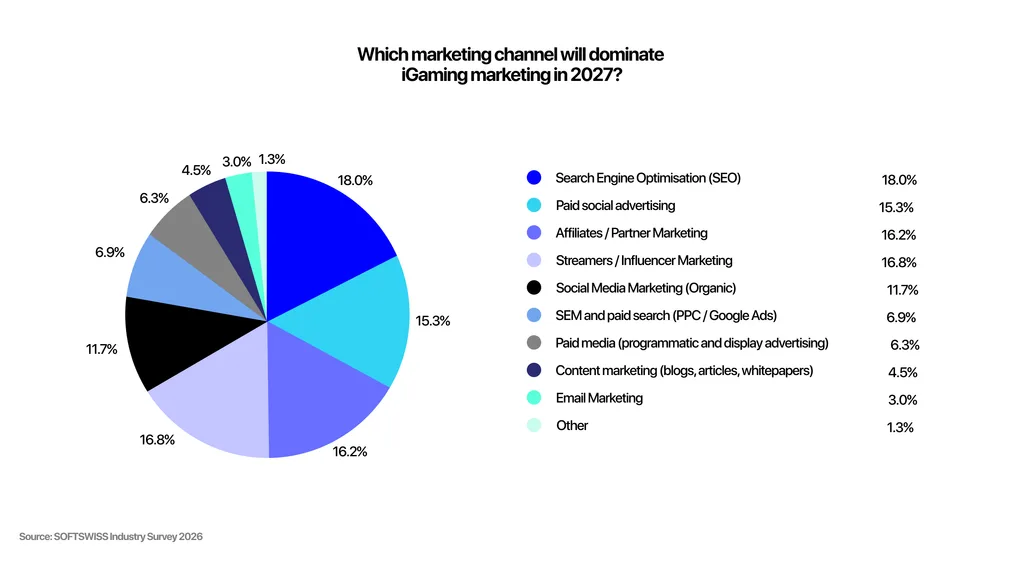
There may be no single winning acquisition channel in 2027. The report puts SEO at 18%, streamer and influencer marketing at 16.8%, and affiliates or partner marketing at 16.2%. The gap is narrow enough to show how fragmented the market has become.
“I’d be wary of anyone claiming that a single channel will dominate iGaming acquisition in 2027. Affiliates will still matter enormously, but their role is changing. The strongest are becoming media brands, entertainment platforms, or highly developed acquisition businesses that combine SEO, PR, social media, paid media, and AI. Some are already operating almost like agencies,” said Martin Calvert, Marketing Director at All-In Global.
Source: 2027 SOFTSWISS iGaming Trends Report
Growth Continues, but the Rules Are Changing
The global online gambling market is expected to generate $349 billion in GGR in 2026, with iGaming forecast to grow at a 9% CAGR between 2027 and 2031. That is strong growth, but below the industry’s historical 29.95% CAGR between 2019 and 2026.
The industry is therefore entering a new phase, where growth is more measured, and regulation is heavier. The report gives iGaming a regulatory-load score of 5/5, the highest in its cross-industry comparison. This means that operational discipline, compliance and the ability to adapt to different markets will matter increasingly more.
That tension is especially visible in Asia and the Middle East. The region represents a huge $162.8 billion online gambling market in 2026, but only 15% is onshore, leaving most activity outside regulated domestic frameworks.
People As a Competitive Advantage
The report’s hiring outlook suggests that the industry is becoming more selective as well as more technological. Employers want rare combinations of skills across areas such as compliance, finance, AI, technical certification, localisation, CRM and marketing. AI is also becoming a baseline competence rather than a niche speciality.
The result is a paradox: companies may need fewer people for routine work, but they need more specialised people for the work that remains. In Europe, employers are reportedly now hiring at a 90–95% skills match, compared with 75–80% previously, making recruitment processes longer.
“The market is no longer short of candidates, it is short of people who have scaled and stayed. The most disciplined studios are restructuring around small, elite teams – one reduced headcount by roughly 30% and raised title-quality scores by more than 40% in a year,” said Steve Kirk, Managing Consultant, Conexus Leadership.
To Sum up
iGaming is becoming an increasingly technologically sophisticated industry, where AI, payments, mobile, regulation, marketing and player experience overlap. The operators that win may be the ones that can connect all of these pieces — all the while making the experience feel simpler for the player.